From Descartes to Smarter Deburring: How Coordinates Enable Automated Back-Burr Removal
What does a fly on a ceiling have to do with CNC machining? More than you might think.
Back burrs at the point where holes intersect are one of the most awkward deburring problems in machining. They sit out of sight, they are hard to reach, and removing them by hand is slow and difficult to keep consistent. This article explains how the coordinate thinking behind every NC program can be used to find those edges and remove back burrs automatically.
The story of Descartes and the fly
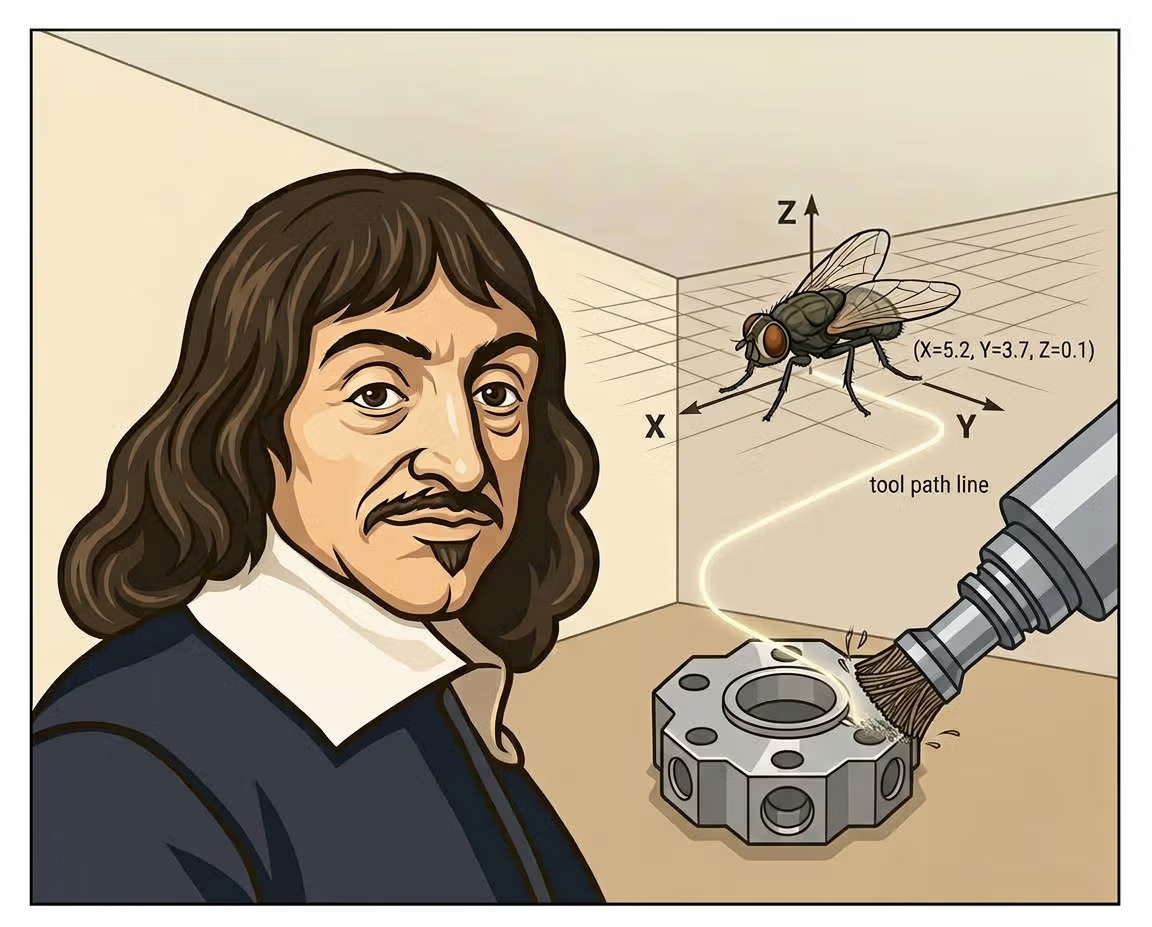
The story goes that the French philosopher and mathematician René Descartes was lying in bed, watching a fly move around the ceiling. He realised he could describe the fly's position at any moment using just its distances from two adjacent walls. Whether or not it happened exactly this way, the anecdote is a popular way of explaining the idea behind the Cartesian coordinate system: any point in space can be described by a small set of numbers.
Add a third direction for height, and you have the familiar X, Y and Z axes. Those three numbers are enough to locate any point on a part.
Why coordinates matter in CNC machining
Every CNC machine tool works in Cartesian coordinates. An NC program is, at its core, a list of positions and movements: go to this X, Y and Z position, then move along this path. The accuracy and repeatability of CNC machining come from the fact that every position on the part can be defined precisely and returned to exactly.
The same principle applies to deburring. If the position of an edge can be described with coordinate data, a machine can be told exactly where to go to treat it, and it can do so in the same way every time.
What are back burrs, and why are they hard to remove?
A back burr is a burr that forms on the exit side of a machined feature. In cross-hole geometry, where one hole intersects another, burrs can form along the intersection edge inside the part. These edges are:
- Hard to see. They are inside the part, often with no direct line of sight.
- Hard to reach. Access is limited by the diameter and angle of the holes.
- Hard to deburr consistently by hand. Results depend on the operator, and the work is slow and repetitive.
Burrs left in these locations can cause problems later, such as interfering with assembly, obstructing flow in fluid passages, or breaking loose in service. For that reason, many applications require them to be removed reliably and repeatably.
How the XEBEC Back Burr Cutter & Deburring Tool Path works
The XEBEC Back Burr Cutter & Deburring Tool Path combines two elements:
- a specialised cutter designed for back-burr removal, and
- a custom-made NC tool path that tells the machine where the cutter needs to go.
The principle follows directly from Descartes' idea:
- Define the edge. The position of the edge is defined with coordinate data.
- Follow the geometry. Using that data, the cutter follows the intersecting-hole geometry, including edges that are hard to see.
- Remove the burr automatically. The back burr is removed as part of the machining program, without manual intervention.
Benefits of automated back-burr removal
- Repeatability. A defined tool path follows the same route every time, rather than relying on operator feel.
- Access to hidden edges. Coordinate data allows the cutter to reach edges that cannot easily be seen.
- Less manual work. Deburring becomes part of the machining program instead of a separate manual step.
- A more consistent process. Once the edge is defined precisely, back-burr removal becomes a repeatable part of production.
Frequently asked questions
What is a back burr?
A back burr is a burr formed on the exit side of a machined feature. In cross holes, it can form where one hole meets another, inside the part.
How do you remove burrs from intersecting holes?
Burrs at hole intersections can be removed by hand, but this is slow and varies between operators. An automated approach uses a specialised cutter and an NC tool path based on coordinate data, so the cutter follows the edge automatically as part of the machining program.
What is the XEBEC Back Burr Cutter & Deburring Tool Path?
It is a solution that combines a specialised cutter with a custom-made NC tool path. The position of the edge is defined with coordinate data, which allows the cutter to follow hard-to-see intersecting-hole geometry and remove back burrs automatically.
Can back-burr removal be automated on a CNC machine?
Yes. When the edge position is defined with coordinate data, back-burr removal can be built into the NC program and carried out automatically.
Need to automate back-burr removal?
If you have cross-hole or intersecting-hole parts where back burrs are slowing production or causing quality problems, get in touch. We can talk through your application and the options available.