Metallographic Cold Mounting: Resin Selection and Defect-Free Results
Cold mounting is a cornerstone technique in metallographic sample preparation, offering a reliable method of embedding specimens in room-temperature curing resins without exposing them to the heat and pressure associated with hot mounting. For laboratories working with delicate, heat-sensitive, or already heat-treated materials, mastering the cold mounting process is essential to preserving the true microstructure of specimens and ensuring accurate, repeatable analysis.
While the technique may appear straightforward, achieving consistently high-quality mounts requires careful attention to resin selection, mixing ratios, pouring technique, temperature control, and curing conditions. Poor preparation decisions, even subtle ones, can introduce artefacts that compromise the integrity of your metallographic analysis.
This guide walks through every stage of the cold mounting process, from choosing the right resin system to troubleshooting common defects, with practical advice for producing void-free mounts with excellent edge retention across a wide range of materials.
What Is Cold Mounting and Why Does It Matter?
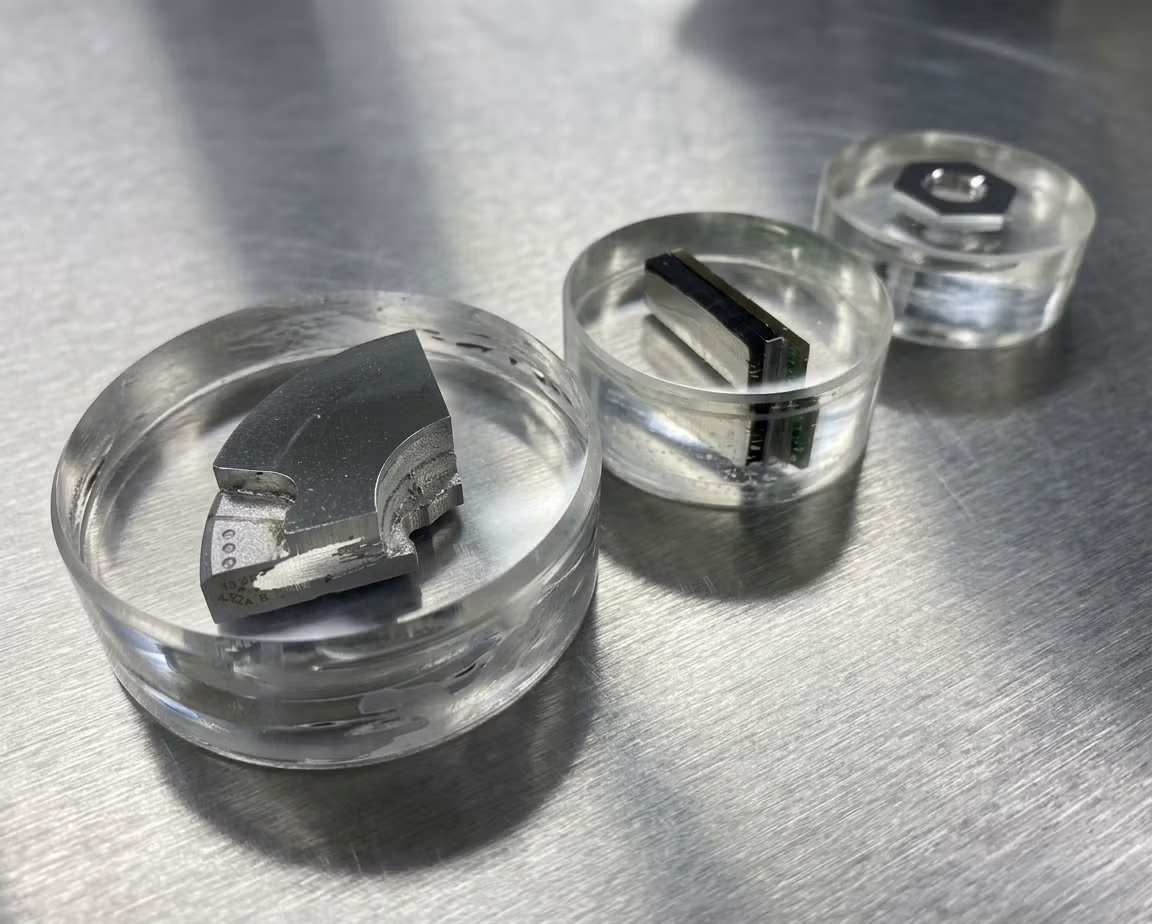
Cold mounting involves embedding a metallographic specimen within a resin that cures at or near room temperature, without the application of external heat or pressure. The resulting mount provides a rigid, handleable form that protects the specimen during grinding, polishing, and microscopic examination.
The primary purpose of cold mounting is to preserve the original microstructure of the sample throughout preparation. By eliminating thermal stress entirely, it ensures that heat-sensitive materials such as polymers, low-melting alloys, coated surfaces, electronic components, and heat-treated steels are examined in their true metallurgical state rather than one altered by the preparation process itself.
Cold mounting also accommodates irregular specimen geometries that would be difficult to grip or align during polishing, and it allows multiple specimens to be prepared from a single resin mix, making it well suited to high-volume laboratory workflows.
When to Choose Cold Mounting Over Hot Mounting
Hot mounting is faster, typically completing in 15 to 30 minutes, but it subjects specimens to temperatures of 150 to 180°C and pressures exceeding 290 bar. For many materials, this is entirely acceptable. For others, it introduces unacceptable risk of structural change.
Cold mounting is the preferred choice when:
- Working with heat-sensitive materials such as polymers, zinc, tin, or lead-based alloys, or soldered assemblies
- Analysing specimens with established thermal histories that must not be disturbed, such as precipitation-hardened aluminium alloys or quenched and tempered steels
- Examining corrosion products, oxides, or surface treatments that may transform at elevated temperatures
- Preparing porous materials including sintered metals and powder metallurgy components that benefit from full resin impregnation
- Mounting coated surfaces, electronic components, or specimens where edge retention is paramount
The trade-off is time: cold mounting typically requires several hours to cure fully, compared to the rapid cycle of a hot press. However, this investment is justified by the fidelity of the resulting microstructure.
Kemet Cold Mounting Resin Systems
Selecting the correct resin for a given application is one of the most consequential decisions in the cold mounting process. Kemet offers a range of epoxy and acrylic cold mounting systems to suit different specimen types, analysis requirements, and throughput demands.
| Product | Type | Mix Ratio | Cure Time | Hardness | Shrinkage | Colour | Key Applications |
|---|---|---|---|---|---|---|---|
| KEPT Epoxy | Epoxy | 2:1 by weight | 10h at 25°C | 75 Shore D | Low | Clear | Porous materials, coatings, electronic components |
| Demotec 20 | Acrylic | 1:1 by weight | 10 mins | 90 Shore D | Low | Clear | General purpose, documentation, inclusion rating |
| Demotec 70 | Conductive acrylic | 1:1 by weight | 18 mins | 62 Shore D | Medium | Black | SEM/EDS on non-conductive specimens |
| Acrylic VLB | Acrylic | 2:1 by volume | 10 mins | 90 Shore D | Low | Blue | General purpose, high-volume QA |
| Acrylic Green | Acrylic | 2:1 by volume | 10 mins | 87 Shore D | N/A | Green | Surface replication, high-contrast teaching samples |
Kemet also offers Kemset Transparent Dye, available in yellow and blue, for creating a coloured see-through finish when used with KEPT Epoxy. This is useful for documentation and sample identification.
Epoxy vs. Acrylic: Choosing the Right Chemistry
The choice between epoxy and acrylic resin systems involves balancing mechanical properties, processing speed, and specimen requirements.
Epoxy resins such as Kemet's KEPT Epoxy offer superior edge retention, low shrinkage, and excellent compatibility with porous specimens. Their low viscosity allows effective penetration into fine pores and cracks, particularly when vacuum impregnation is used. The principal limitation is cure time, typically 8 to 24 hours at room temperature, with full mechanical properties developing over 72 hours. Heat generation during curing is minimal, making epoxies the safest option for the most sensitive specimens.
Acrylic resins cure significantly faster, typically within 10 to 20 minutes, making them well suited to high-throughput environments and routine quality assurance work. However, acrylics exhibit higher shrinkage and lower hardness than epoxies, and their exothermic curing reaction generates more heat. Where processing speed is more important than absolute edge precision, acrylics offer excellent practical value.
| Property | Epoxy | Acrylic |
|---|---|---|
| Hardness | 75-90 Shore D | 62-90 Shore D |
| Shrinkage | Low | Low to medium |
| Cure Time | 8-24 hours | 10-20 minutes |
| Edge Retention | Superior | Moderate |
| Heat Generation | Minimal | Higher |
| Best For | Porous, coated, or sensitive specimens | Volume processing, general purpose |
Cold Mounting for Fragile and Heat-Sensitive Specimens
Certain materials present particular challenges that cold mounting is uniquely positioned to address.
Brittle specimens such as ceramics, thermal spray coatings, sintered components, and some composite materials can fracture or delaminate under the mechanical stresses of standard preparation. Cold mounting supports these materials from all sides, reducing the risk of damage during grinding and polishing.
Heat-sensitive alloys with low melting points may approach or reach their transformation temperatures in a hot press. Cold mounting eliminates this risk entirely. Similarly, materials with carefully controlled microstructures, including hardened steels, age-hardened aluminium alloys, and precision heat-treated components, must not be subjected to further thermal cycles that could alter phase distributions or residual stress states.
For porous materials, cold mounting enables vacuum impregnation, a technique that draws resin into voids before atmospheric pressure is restored, achieving complete fill of pores and open-porosity networks. This is essential for powder metallurgy parts, thermal spray coatings, archaeological samples, and any specimen where internal porosity must be preserved and supported for sectioning.
Step-by-Step Cold Mounting Process
1. Sample Cleaning and Mould Preparation
Contamination is one of the most common causes of adhesion failure and surface segregation in cold mounts. Clean specimens thoroughly using ultrasonic agitation in acetone or isopropanol, then allow them to dry completely before mounting. Residual moisture can interfere with resin curing and create interfacial voids.
Select a mould appropriate to the specimen size. Silicone and polyethylene moulds are preferred for their release properties and reusability. Apply a thin, even coat of release agent to the mould interior, avoiding pooling. Secure the specimen in the correct orientation using mounting clips or double-sided tape to prevent drift during pouring.
2. Mixing and Pouring
Adhere strictly to the manufacturer-specified mix ratios. Epoxy systems are typically mixed by weight; acrylic systems by volume. Use a precision balance (±0.1g) for weight-based mixing. Mix slowly and thoroughly for 60 to 90 seconds, scraping the sides and base of the container to ensure complete incorporation, while minimising air entrainment.
Pour the mixed resin down the inside wall of the mould in a single continuous motion rather than directly onto the specimen. Immediately after pouring, tap the mould gently on the work surface or use a vibration table to encourage trapped air to rise. For porous specimens, transfer to a vacuum chamber at this stage.
3. Temperature Control During Curing
Optimal curing occurs between 20 and 25°C. Temperatures below 18°C significantly extend cure times; temperatures above this range can accelerate exothermic reactions, particularly with acrylics, potentially generating sufficient heat to damage sensitive specimens. For large mounts or fast-curing acrylics, water bath cooling can help manage heat build-up. Maintain relative humidity below 60% throughout curing, as moisture can impair hardening.
Each 10°C increase in ambient temperature roughly doubles the cure rate. This is a useful lever when throughput is a priority, but one that requires caution with heat-sensitive specimens.
4. Curing Duration and Demolding
Acrylic resins typically reach sufficient hardness for demolding within 30 to 40 minutes, though full cure develops over 24 hours. Epoxy systems generally require 8 to 24 hours before demolding, with full mechanical properties achieved after 72 hours.
To demold, flex the mould sides away from the mount rather than pulling or levering directly. Inspect the mount immediately under good lighting: the surface should be uniform, fully hardened, and free from soft spots or tackiness. Any sign of incomplete curing indicates the need for further conditioning before proceeding to preparation.
Void-Free Mounting: Techniques and Defect Prevention
Vacuum Impregnation
For porous specimens, vacuum impregnation is the most reliable method of achieving complete resin fill. Place the specimen and freshly mixed resin in the vacuum chamber and apply a vacuum of approximately 25 to 30 inHg for 5 to 10 minutes. As air is evacuated from the specimen's pores, bubbles will be seen rising through the resin. When the vacuum is released, atmospheric pressure drives the resin into the evacuated voids, achieving thorough impregnation with minimal residual porosity.
Minimising Air Bubbles
Air inclusion during mixing and pouring is the single most common cold mounting defect. Reduce it by mixing slowly, pouring in one continuous stream, tapping the mould immediately after pouring, and applying pressure curing (2 to 3 bar) where equipment allows. For epoxy resins, degassing the resin component under vacuum before adding the hardener can further improve results.
Edge Retention for Brittle Specimens
Low-shrinkage resins are fundamental to good edge retention. KEPT Epoxy's low shrinkage makes it the preferred choice for edge-critical applications. Where specimens have particularly fragile edges or corners, surrounding them with metal filler particles before pouring distributes mechanical stress more evenly during both curing and subsequent grinding.
Common Defects and Their Causes
| Defect | Likely Cause | Remedy |
|---|---|---|
| Incomplete curing | Incorrect mix ratio or low temperature | Recheck ratios; cure at 20 to 25°C |
| Air bubbles | Rapid mixing or direct pouring | Mix slowly; pour down mould wall |
| Shrinkage cracks | Excessive exothermic heat | Use staged curing; consider epoxy |
| Resin pullout during polishing | Resin too soft for abrasive | Switch to harder formulation |
| Surface contamination | Inadequate pre-cleaning | Ultrasonic clean before mounting |
Post-Mounting: Polishing and Inspection
Polishing Cold-Mounted Specimens
Cold-mounted specimens are typically softer than hot-mounted equivalents and require adjusted polishing parameters. Begin with planar grinding at 120 to 240 grit to establish a flat reference surface, then progress through finer abrasives:
- 320/400 grit: medium pressure (20 to 25 N)
- 600/800 grit: reduced pressure (15 to 20 N)
- 1200 grit: light pressure (10 to 15 N)
- Final polish (3 to 1 µm): minimal pressure (5 to 10 N)
Epoxy mounts tolerate higher polishing pressures than acrylics. For acrylic mounts, keep polishing times short to avoid frictional heat build-up and specimen pullout.
Final Inspection
After initial polishing, examine the mount at 10 to 50x magnification, looking for:
- Dark voids at or near the specimen edge, indicating incomplete impregnation
- Microcracks emanating from angular specimen corners
- Edge rounding or material pullout at specimen borders
- Resin separation from the specimen surface
Minor defects identified early in the polishing sequence can sometimes be addressed by adjusting pressure or switching to a finer abrasive. Significant voids or cracks typically warrant remounting rather than proceeding with a compromised specimen.
Frequently Asked Questions
Can I mount multiple small specimens in a single cold mount?
Yes. Keep specimens separated by at least 2 mm and use a slow-curing epoxy to allow all pieces to settle without drifting before the resin gels.
How do I manage the odour from acrylic resins?
Work under local exhaust ventilation. Store the liquid hardener component at around 10°C and replace container lids immediately after use.
Is coloured resin compatible with SEM work?
Organic dyes can charge under the electron beam. For SEM and EDS applications, use a graphite-filled conductive resin such as Demotec 70, and apply conductive paint to the puck edges.
Why does my mount feel tacky after the stated cure time?
Tackiness indicates incomplete curing, usually caused by an incorrect mix ratio, low ambient temperature, or high humidity. Return the mount to controlled conditions (20 to 25°C, below 60% RH) and allow additional curing time before demolding.