Grinding vs Polishing: What's the Difference and When Should You Use Each?
Grinding and polishing are two of the most commonly confused processes in surface preparation yet they serve fundamentally different purposes. While both involve abrasive materials and are often used in sequence, confusing one for the other can lead to poor results, wasted time, and unnecessary material damage. Whether you work in automotive manufacturing, metallography, or jewellery production, understanding the distinction between grinding and polishing is essential for achieving the right surface finish every time.
What is Grinding?
Grinding is a precision abrasive machining process that removes material from a workpiece in a controlled and deliberate manner. Compared to other methods such as milling or turning, grinding offers a higher degree of accuracy and is capable of producing very flat, consistent surfaces using abrasive grains.
The Purpose of Grinding in Material Preparation
The primary role of grinding is to prepare a material for further processing or for its final application. It removes saw marks, surface distortions, scratches, and other imperfections introduced during earlier manufacturing stages. In metallographic preparation specifically, grinding creates a flat, uniform surface by eliminating irregularities that could compromise the integrity of subsequent analysis or finishing work.
When carried out correctly, grinding achieves tight dimensional tolerances and is well suited to applications where precision is non-negotiable. While it is often associated with fine finishing, typically removing between 0.25 mm and 0.50 mm of material, roughing operations using grinding can also remove significant volumes of material quickly to simplify later processing steps.
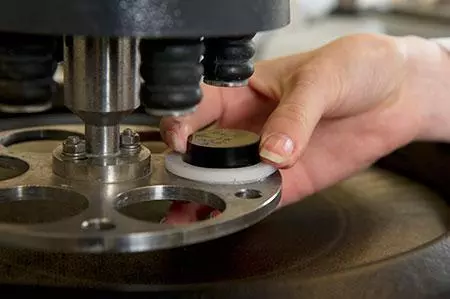
Grinding is generally split into two stages:
Plane Grinding removes high spots and establishes a flat, level baseline across the surface.
Fine Grinding progressively reduces surface roughness in preparation for polishing, with each pass refining the surface further than the last.
Types of Abrasives Used in Grinding
The choice of abrasive has a significant impact on grinding performance. Key options include:
Aluminium Oxide (Al₂O₃) is available in standard, semi-friable, and friable grades and is the go-to abrasive for steel, iron, and other ferrous metals. Variants include white high-purity alumina and versions supplemented with chromium or zirconium for added toughness.
Silicon Carbide (SiC) is the second hardest abrasive after diamond and is well suited to non-ferrous metals and ceramics. It comes in black (97.5% SiC) and green (99% SiC) grades.
Ceramic Alumina offers superior impact resistance and performs well in high-speed grinding applications and with harder materials.
Diamond Abrasives are the hardest and most durable option, reserved for extremely hard materials where other abrasives would wear too quickly.
As a general rule, the abrasive should always be harder than the workpiece material. Coarser abrasives typically require higher speeds and lighter applied force.
Common Grinding Machines and Equipment
Surface Grinders use an abrasive wheel, magnetic chuck, and rotary table to produce flat surfaces with high precision.
Cylindrical Grinders operate similarly to surface grinders but feature a movable wheel to accommodate cylindrical workpieces.
Centerless Grinders use two rotating wheels and allow for continuous throughput, making them ideal for high-volume finishing.
Tool and Cutter Grinders carry multiple wheel configurations for sharpening and manufacturing cutting tools.
Other common grinding equipment includes jig grinders, gear grinders, bench grinders, and belt grinders, each suited to specific manufacturing needs. The range and precision of available grinding machinery make it indispensable wherever surface quality and dimensional accuracy are critical.
What is Polishing?
Polishing is the final stage of surface preparation and is focused entirely on refinement rather than material removal. The goal is to produce a smooth, visually appealing surface that is free from the microscopic irregularities left behind by grinding.
Polishing as a Surface Refinement Process
Where grinding shapes and sizes a material, polishing improves its surface without significantly changing its dimensions or geometry. It works by progressively applying finer abrasives to remove scratches and surface defects until the desired level of smoothness is reached. The result is a surface that is not only cleaner and more attractive but also easier to analyse under a microscope or inspect for flaws.
Modern Polishing Techniques
Mechanical Polishing uses polishing cloths, wheels, sandpaper, or diamond pads to physically refine the surface. With the right consumables and process parameters, roughness values as low as 0.008 μm Ra can be achieved.
Chemical Polishing immerses the workpiece in a chemical solution that selectively dissolves surface high spots, smoothing out micro-roughness without physical abrasion. This technique is particularly useful for metals that are difficult to polish mechanically.
Electrolytic Polishing combines an electrical current with a chemical electrolyte to remove surface material efficiently, targeting burrs and surface irregularities with a high degree of control.
Polishing Abrasives and Compounds
Diamond Abrasives were originally supplied as pastes but are now widely available as aerosols and slurries. They offer fast cutting speeds and are commonly used in the early stages of polishing.
Aluminium Oxide (Al₂O₃) in fine powder form is a popular choice for final polishing stages, offering reliable results on a wide range of materials.
Colloidal Silica provides a combined chemical and mechanical polishing action, producing clean, damage-free surfaces with less risk of inducing surface deformation than harder abrasives.
What Surface Finish Can You Expect After Polishing?
A well-polished surface displays uniform electrical potential, a slightly rounded surface profile, and significantly improved cleanability. Surfaces typically appear mirror-like, though they may still contain minimal microscopic concavities at the finest scale. Surface finish quality is measured using the Roughness Average (Ra), which quantifies deviation from a mean surface line.
Grinding vs Polishing: Key Differences Explained
Material Removal vs Surface Smoothing
Grinding is an aggressive process designed to remove material and achieve dimensional accuracy. Polishing is a refining process that improves surface texture without significantly altering shape or size. Grinding uses bonded abrasives for high material removal rates while polishing relies on loose abrasives that work with a gentler smoothing action.
Abrasive Hardness and Aggressiveness
Grinding employs coarser, harder abrasives suited to rapid stock removal. Polishing uses much finer particles, often suspended in water-based, oil, or alcohol lubricants to minimise surface damage during the finishing process.
Visual and Structural Outcomes
Grinding leaves behind a surface with fine micro-scratches and can introduce residual stress into the material, in some cases leading to micro-cracking if parameters are not carefully controlled. Polishing removes this micro-damage, eliminating micro-cracks and voids to produce a clean, scratch-free, mirror-quality surface.
Choosing Between Grinding and Polishing: Material and Application Considerations
Selecting the Right Process for Your Material
Ferrous metals such as steel and iron typically follow a standard grinding sequence before diamond abrasive polishing. Steel in the 35 to 65 HRC hardness range can generally be prepared using a straightforward three-stage grinding process. Heat-sensitive alloys including tool steels, stainless steels, and high-nickel alloys require reduced speeds and appropriate coolants to prevent thermal damage.
Non-ferrous metals such as aluminium, zinc, and brass are softer and more prone to becoming gummy during aggressive processing. Low-pressure grinding helps avoid excessive chip formation, while colloidal silica is the preferred choice for final polishing of aluminium. Silicon carbide emulsions offer a good balance of cutting speed and consumable longevity for other non-ferrous applications.
Ceramics demand diamond abrasives throughout both grinding and polishing stages due to their exceptional hardness. Polishing times for ceramics are typically longer than for metals before a satisfactory surface finish is achieved.
Composite materials present unique challenges due to the varying properties of their constituent phases. Careful pad selection and low-force polishing are essential to avoid resin smearing or fibre pull-out.
Application-Specific Recommendations
The intended end use of a surface is often the clearest guide to which process is required. For concrete floors in good condition, polishing alone may be sufficient. For older, heavily damaged floors, grinding followed by sealing is the more appropriate approach.
For laboratory specimens destined for optical microscopy or scanning electron microscopy (SEM), fine mechanical or chemical polishing is required. Specimens prepared for X-ray diffraction (XRD) or glow discharge spectroscopy (GDS) need a reliably flat surface above all else. In spectral analysis applications where cross-contamination must be avoided, dedicated grinding papers or foils are preferred despite their higher cost.
Microscopic Analysis Requirements
The magnification and analytical method being used directly determines how thoroughly a specimen must be prepared. High-magnification optical microscopy, electron microscopy, and microhardness testing all demand a mirror finish, typically achieved through progressively finer grinding followed by multi-stage polishing. Where edge retention is critical, for example in composite cross-sections or cast metals where inclusions must be preserved, a slightly less refined but structurally faithful finish may be more appropriate than an optical mirror.
Rushing polishing or skipping preparation stages consistently leads to poor data quality. Equally, over-polishing can be damaging, particularly with soft materials or specimens containing phases of significantly different hardness.
Common Grinding and Polishing Mistakes and How to Avoid Them
Over-Grinding and Thermal Damage
Excessive heat generated during grinding can alter the microstructure of a material, particularly in thin specimens. This thermal damage typically results from incorrect wheel speed, insufficient coolant flow, or poorly specified grinding wheels. Matching wheel surface speed to coolant delivery rate, and using appropriately dressed wheels, keeps heat generation under control and protects surface integrity.
Poor grinding quality cannot be corrected by polishing alone. Each grinding stage must fully remove the damage introduced by the previous one before the next stage begins. Skipping grit sequences to save time invariably creates more work later and compromises final surface quality.
Contamination and Embedded Abrasives
Cleaning between each preparation stage is not optional, it is essential. Residual grit, dust, and other contaminants from earlier stages can scratch polished surfaces and reduce the effectiveness of polishing compounds. Harder abrasive particles from grinding can become embedded in softer workpiece materials, producing characteristic comet-tail defects that only become visible during polishing.
Incorrect Lubrication of Polishing Cloths
Using too little lubricant increases friction and the risk of scratching during polishing. Using too much is equally problematic, as it can wash abrasives away from polishing discs and reduce cutting efficiency. Polishing cloths should be kept slightly damp, not saturated, with just enough lubricant to suit the hardness of the material and the grit size being used.
Getting the Most from Grinding and Polishing
Grinding and polishing are complementary processes, but they are not interchangeable. Grinding removes material to establish shape, flatness, and dimensional accuracy. Polishing refines the surface to remove microscopic damage and produce a clean, smooth, and visually consistent finish.
Selecting the right approach depends on your material type, the level of surface detail required, and the intended application, whether that is microscopic analysis, spectroscopy, or a high-quality aesthetic finish. Following the correct sequence, using appropriate abrasives at each stage, and avoiding common pitfalls such as skipping grit sequences or neglecting inter-stage cleaning are what separate a professional result from a compromised one.
When both processes are applied correctly and in the right order, raw materials are transformed into precisely finished components that meet both functional performance requirements and the highest standards of surface quality.