When a Deburring Brush Escapes the Edge: A Plunging Fix for Titanium
Edge deburring with a ceramic fibre brush is usually straightforward. The brush follows the edge, the bristles do the work, and the burr is gone. Occasionally, though, the geometry of the part works against you. This case study looks at one of those situations on a titanium aerospace component, and at the simple change that solved it.
| Application | Material | Tool |
|---|---|---|
| Aerospace component | Titanium | XEBEC Brush™ Surface, A32-CB06M |
- Problem: the brush deflected away from the edge, giving inconsistent deburring
- Cause: only about 1 mm of engagement between brush and edge
- Solution: change from a conventional feed motion to a plunging motion, and reduce brush projection from 30 mm to 10 mm
- Result: stable contact and consistent burr removal
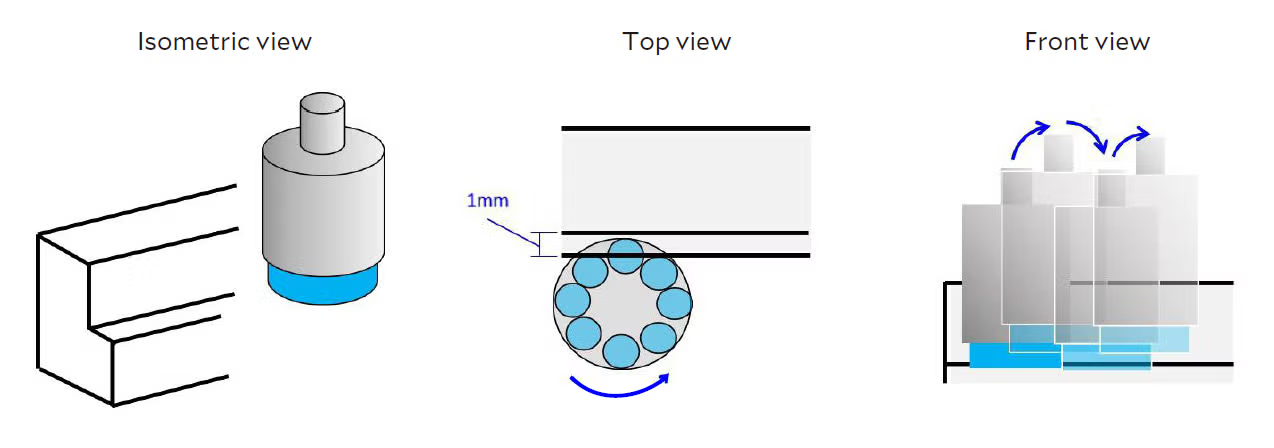
The challenge: a brush that will not stay on the edge
The customer needed to remove a burr from the edge of a titanium component. The brush was programmed to travel along the edge with only approximately 1 mm of engagement.
Because the engagement was so small, the brush tended to deflect away from the edge instead of maintaining stable contact. Rather than a steady, controlled cut, the bristles skated off the edge, which made it difficult to achieve consistent deburring along the full length of the part.
Why low engagement causes deflection
A brush is a bundle of flexible bristles, and it behaves differently from a rigid cutting tool. When the brush is fed sideways along an edge, the contact force pushes the bristles away from the workpiece. With deep engagement, a large share of the bristles is in contact and the tool is held against the edge. With very little engagement, only a small number of bristles touch the edge, there is little to hold the brush in position, and the sideways force is enough to push it clear.
The longer the brush projects from the holder, the more easily it bends. In this application the projection was 30 mm, which made the problem worse.
The solution: plunge instead of feed
The fix was surprisingly simple: change the machining method from a conventional feed motion to a plunging motion.
Instead of dragging the brush sideways along the edge, the brush is plunged onto the target area. Loading the brush in this way keeps the contact stable, even with limited engagement, and the result was successful, consistent burr removal.
Conventional feed versus plunging
| Conventional feed motion | Plunging motion | |
|---|---|---|
| How the brush moves | Travels along the edge | Plunges onto the target area |
| Behaviour at about 1 mm engagement | Brush tends to deflect away from the edge | Contact stays stable |
| Deburring result | Inconsistent | Consistent |
Second improvement: shorter brush projection
In this case the brush projection was also reduced from 30 mm to 10 mm. A shorter projection makes the brush more rigid, so it resists bending under load. That increased rigidity further improved the process.
If you are seeing deflection on any brush application, projection is one of the first things to check. Use the shortest projection that still lets the brush reach the feature.
Technical tip
When only a small portion of the brush can engage with an edge, do not rely only on conventional feed machining. If the brush tends to escape or deflect sideways, consider a plunging approach to stabilise brush contact.
Troubleshooting checklist
If your brush is escaping from an edge, work through these points:
- Check the engagement. Is only a small part of the brush touching the edge? If so, a feed motion may not hold the brush in place.
- Try a plunging motion. Move the brush onto the target area rather than dragging it along the edge.
- Reduce the projection. A shorter projection gives a stiffer brush. Here it was cut from 30 mm to 10 mm.
- Review the result along the whole edge. Consistency is the goal, so check the start, middle and end of the deburred edge and not just one location.
- Adjust one variable at a time. This makes it clear which change improved the process.
Need help with a difficult edge?
If you have an application where the brush will not stay on the edge, or where deburring results are inconsistent, get in touch. We can help with tool selection and process set-up.